Over the past two decades, I've tried to get vegetarians, and especially vegans, to rethink their diet. I've told them that humans are adapted to eat eggs, fish, shellfish, and meat; that if they didn't eat these foods, they were threatening their future health and well-being. I don't think I was at all successful, perhaps because I've never been a vegetarian myself. I hadn't been a true believer. And vegetarianism/veganism is a belief system.
Then I read Lierre Keith's The Vegetarian Myth: food, justice, and sustainability. It is a clarion call to vegetarians and vegans from a former vegan who followed their dietary tenets religiously for 20 years,and in the process destroyed her health and probably reduced her lifespan.
But this book is not just for vegetarians. It is written for all of us because it is about food and what our diets, no matter what we eat, are doing to the soil of the Earth, which is also the soul of the Earth.
Lierre Keith is a passionate writer who makes you feel her pain and despair. She desperately wanted the vegan lifestyle to be the salvation not only for herself, but for Earth and all its living organisms. But after 20 years, and near death, she finally realized that her diet was killing her. And when she began to really study the process of food acquisition, Keith also realized that the vegan diet was killing the Earth. Instead of being Earth's salvation, it was Earth's doom.
This may sound overly dramatic, but once you read her book and digest all the research she has done, you will realize that I have only stated the basic facts.
As a biological anthropologist, I can state that we have known since at least the mid-1980s that the origins of agriculture began a destructive process which is only accelerating. Humans are not meant to live on a grain-based diet. When grains are the primary source of nutrition, health is compromised. Just this week (6/18/2011), another study was published detailing the decline and fall of health with the rise of agriculture: http://www.sciencedaily.com/releases/2011/06/110615094514.htm
Keith approaches the reader as a fellow traveler who wants to do the right thing, and who guides the reader to see the truth even when it conflicts with deeply held beliefs. The major divisions of the book are directed at Moral Vegetarians, Political Vegetarians, and Nutritional Vegetarians. She concludes the book with a plea to Save the World.
As a Moral Vegetarian, Keith states that, "...I had bet my whole moral system--and built my whole identity--on the idea that my life did not require death." Factory farming of animals is a terrible, destructive process. But so is destroying marshes, grasslands, and forests to grow more grains. What about all the killing of those ecosystems to provide the wheat and corn and soy for the vegan's diet? What about the destruction of topsoil? Is that really morally better than eating eggs and fish?
"Find a small wild spot somewhere, the edge of a parking lot, the tree outside your window, and watch. Really watch. This is what you will see: everything is eating and then being eaten, and through it all life endures. This is no hierarchy, only hunger. And it's through our hunger that we participate in the cosmos, in an endless cycle of life, death, and regeneration."
Political Vegetarians believe that their diet will preserve resources to feed the world's hungry. If there are no cows to feed, then more people can be fed. They believe things like: "...a 10-acre farm can support 60 people growing soybeans, 24 people growing wheat, 10 people growing corn and only two producing cattle." Keith responds, "Set aside the fact that a diet of soy, wheat, or corn will result in massive malnutrition--along with fun stuff like kwashiorkor, pellagra, retardation, blindness--and ultimately death." Such a farm will also destroy the soil.
"It is not my project to try to feed every human being that we can produce while we chew the planet to the bone. I'm not asking, How many people can be fed? but a very different question: How can people be fed? Not, What feeds the most people? but What feeds people sustainably? We need a full accounting. The absolute bottom line is: what methods of food production build topsoil while using only ambient sun and rain? Because nothing else is sustainable." [italics in original]
As for Nutritional Vegetarians, "The first myth of the nutritional vegetarians--that we aren't meant for meat--is another fairy tale filled with inedible apples." This myth is the result of research on foraging populations misclassifying all gathered foods (primarily collected by women) as plant foods. Much of what was gathered were actually animal foods: fish, shellfish, "insects, grubs, reptiles, small mammals." The plant foods were primarily nuts, fruits, berries, and tubers. Grains? Not so much.
As Keith points out, citing the extensive analysis of the physical and dental health of foraging populations done by Weston Price in the early 20th century, populations eating a traditional foraged diet were extremely healthy. When they switched to a grain-based Western diet, their health, and especially that of their children, declined. "Of course the food with the most minerals are marine foods, which is why the healthiest people Price found were coastal-dwelling fishing peoples."
Lierre Keith concludes her book with a radical plea to change the world. This may be the most difficult chapter of the book since it requires the most of reader. Keith does not believe that small, incremental change will be able to solve the food production problems. It will require massive, radical change. Since even small changes disturb most individuals, I have grave doubts that the radical changes Keith wants such as the end of agribusiness, the revival of small family farms, eating locally, and massively reducing the human population, will occur until we are left with no choice. At which point, it probably will be too late for us.
I strongly urge everyone to read this book. If nothing else, it should make you think about dirt, our precious topsoil, in a whole new way.
Showing posts with label nutrition. Show all posts
Friday, June 24, 2011
The Vegetarian Myth
Labels:
agribusiness,
brain,
diet,
environment,
grains,
health,
illness,
nature,
nutrition,
omega-3 fatty acids,
society,
sunlight,
vegan,
vegetarian,
women
Tuesday, April 6, 2010
Color It Bright
Let’s say that one of your New Year’s Resolutions was to be healthier. It is now three months down the road. How is that resolution going? Maybe you made some changes, but now you’ve slipped back to old habits.
Change is difficult, especially if you are trying to make big changes. And it may be unclear what would be the best way to change. So let’s start small with a simple dietary change. This change is called Color It Bright.
The biggest mistake that most individuals make when cooking at home or eating out is to have a meal where all or most of the food is in a similar, boring color palette of white, cream, tan, brown. A palette of that color scheme often means fried food (high fat) is present. But the biggest problem is that the nutrient content of such a meal is poor.
For instance, look at this picture of a typical restaurant southern fried chicken dinner. Note that the color scheme is blah: brown fried chicken and fried okra; brown pinto beans; cream/brown corn bread; and creamy coleslaw. BORING!!
This meal will fill you up and will provide you with some protein, but it is high in fat and low in vitamins, minerals, and phytonutrients that are needed for good health. If most of your meals are in the blah, boring color palette, this needs to change.
The best meals are those where two-thirds to three-quarters of the foods you eat are brightly-colored fruits and vegetables: the deeper, the richer the color, the better. If you cook/boil your vegetables until they are a pale imitation of their fresh or frozen state, then you are cooking out the good stuff. It is best to eat fruits and vegetables raw or steamed.
Some of you may be saying, well I have a pretty colorful meal because I eat yellow corn with my chicken. Sorry, but corn is not a fruit or vegetable. It is a grain, so it doesn’t count towards the two-thirds to three-quarters total of brightly-colored, nutrient-dense fruits and vegetables. Nor does yellow cheese count as a colorful food. This is just a saturated-fat version of white milk.
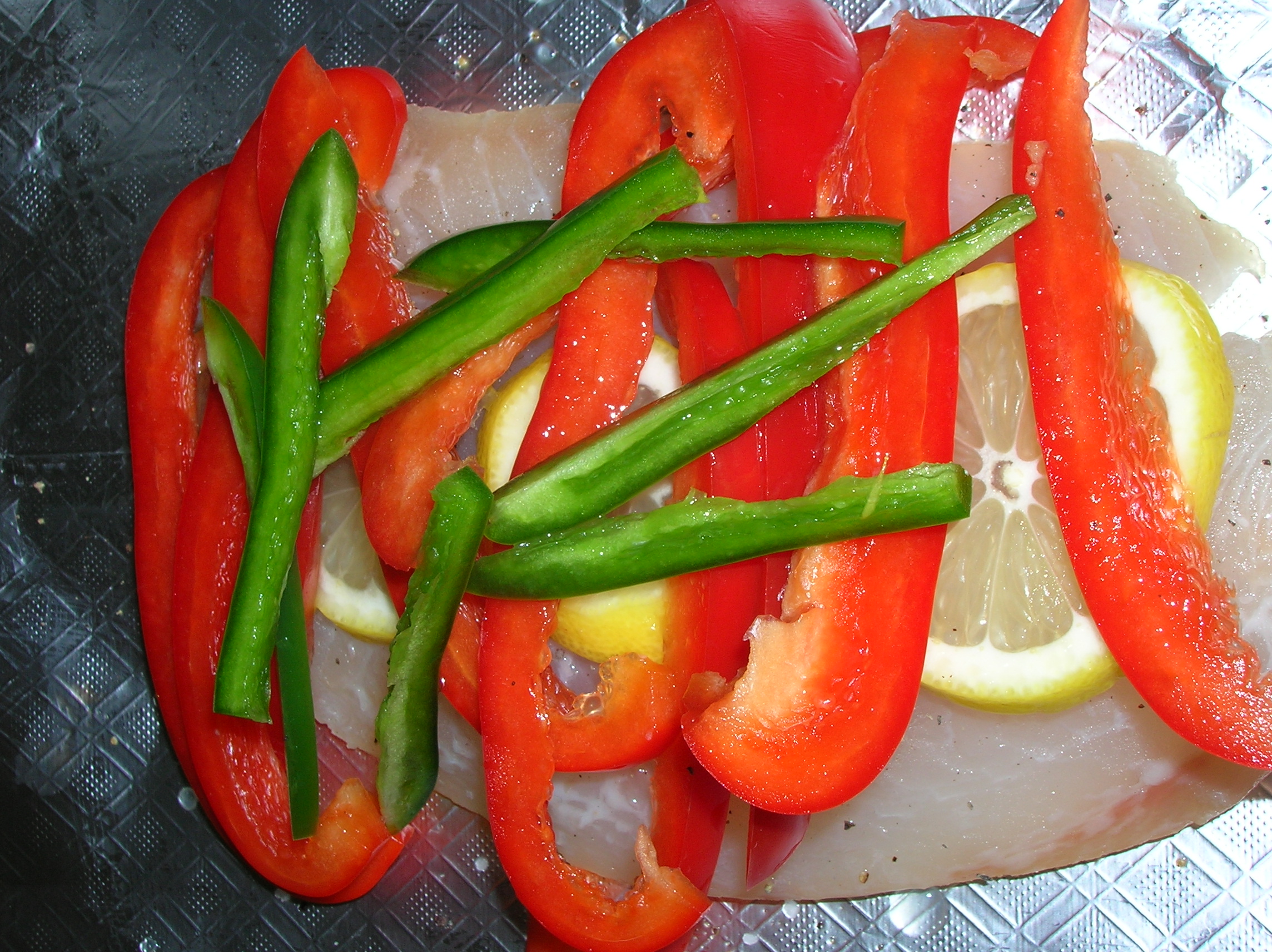
The picture below provides you with a better example of healthy eating. Note that about half of the food on the foil is brightly colored. The other half will be grilled tilapia: an excellent low-fat source of protein, which makes the 50/50 balance acceptable.
For meat and potatoes fans, there are also healthier, colorful options such as shown below. In place of nutrient-poor white potatoes, substitute bright orange sweet potatoes. Make sure the meat portion is only one-third or less of the meal. Add another brightly-colored vegetable, and you are good to go.
Salads are an excellent way to get lots of fruits and vegetables into your meal, but only if richly-colored leaves are used. As noted above, creamy coleslaw is a big no-no. This is also true of salads primarily based on iceberg lettuce. Most leaves of iceberg lettuce are so pale that they contain only the idea of green, not the reality, as is obvious in this salad shown below. Yes, it does include a bit of a bright spot with the few tomato pieces; but otherwise, it is strongly tilted towards the boring end of the eating palette.
On the other hand, the salad shown below hits the right, bright spot for dining pleasure. The leaves are richly colored. There are broccoli florets and cherry tomatoes. And only about one-quarter of the salad is the pale tilapia. You could add some julienned carrots for even more color and nutrition.
Here is another excellent choice: Thai chicken salad which is three-quarters spring greens and spinach and one-quarter grilled chicken.
What about dessert? Pink frosting on confetti cake doesn’t count. Sorry. But you can still make your sweet tooth happy with a beautiful bowl of mixed berries; and get tons of great nutrients in the bargain.
Let’s not forget breakfast. Most of you probably consider breakfast a bowl of cereal with milk. Not a good color scheme. You may add fruit to the cereal, which is better. But the fruit needs to be at least 50% of what is in the bowl to make it a good balance. Or, you could have 25% fruit mixed with cereal, and also eat half a grapefruit.
For those not into cereal, a better option overall is an omelet made with the entire egg, not just the whites. There are lots of good nutrients that your body needs in the yolk. The spinach omelet shown below packs a good and colorful nutrient punch, but could be even better if tomatoes were included.
So make the easy change to eating nutrient-rich meals:
Color It Bright and you will be Eating Right!
Change is difficult, especially if you are trying to make big changes. And it may be unclear what would be the best way to change. So let’s start small with a simple dietary change. This change is called Color It Bright.
The biggest mistake that most individuals make when cooking at home or eating out is to have a meal where all or most of the food is in a similar, boring color palette of white, cream, tan, brown. A palette of that color scheme often means fried food (high fat) is present. But the biggest problem is that the nutrient content of such a meal is poor.
For instance, look at this picture of a typical restaurant southern fried chicken dinner. Note that the color scheme is blah: brown fried chicken and fried okra; brown pinto beans; cream/brown corn bread; and creamy coleslaw. BORING!!
Fried chicken dinner with pinto beans, fried okra, coleslaw, and cornbread.
This meal will fill you up and will provide you with some protein, but it is high in fat and low in vitamins, minerals, and phytonutrients that are needed for good health. If most of your meals are in the blah, boring color palette, this needs to change.
The best meals are those where two-thirds to three-quarters of the foods you eat are brightly-colored fruits and vegetables: the deeper, the richer the color, the better. If you cook/boil your vegetables until they are a pale imitation of their fresh or frozen state, then you are cooking out the good stuff. It is best to eat fruits and vegetables raw or steamed.
Some of you may be saying, well I have a pretty colorful meal because I eat yellow corn with my chicken. Sorry, but corn is not a fruit or vegetable. It is a grain, so it doesn’t count towards the two-thirds to three-quarters total of brightly-colored, nutrient-dense fruits and vegetables. Nor does yellow cheese count as a colorful food. This is just a saturated-fat version of white milk.
The picture below provides you with a better example of healthy eating. Note that about half of the food on the foil is brightly colored. The other half will be grilled tilapia: an excellent low-fat source of protein, which makes the 50/50 balance acceptable.
For meat and potatoes fans, there are also healthier, colorful options such as shown below. In place of nutrient-poor white potatoes, substitute bright orange sweet potatoes. Make sure the meat portion is only one-third or less of the meal. Add another brightly-colored vegetable, and you are good to go.
Salads are an excellent way to get lots of fruits and vegetables into your meal, but only if richly-colored leaves are used. As noted above, creamy coleslaw is a big no-no. This is also true of salads primarily based on iceberg lettuce. Most leaves of iceberg lettuce are so pale that they contain only the idea of green, not the reality, as is obvious in this salad shown below. Yes, it does include a bit of a bright spot with the few tomato pieces; but otherwise, it is strongly tilted towards the boring end of the eating palette.
On the other hand, the salad shown below hits the right, bright spot for dining pleasure. The leaves are richly colored. There are broccoli florets and cherry tomatoes. And only about one-quarter of the salad is the pale tilapia. You could add some julienned carrots for even more color and nutrition.
Here is another excellent choice: Thai chicken salad which is three-quarters spring greens and spinach and one-quarter grilled chicken.
What about dessert? Pink frosting on confetti cake doesn’t count. Sorry. But you can still make your sweet tooth happy with a beautiful bowl of mixed berries; and get tons of great nutrients in the bargain.
Let’s not forget breakfast. Most of you probably consider breakfast a bowl of cereal with milk. Not a good color scheme. You may add fruit to the cereal, which is better. But the fruit needs to be at least 50% of what is in the bowl to make it a good balance. Or, you could have 25% fruit mixed with cereal, and also eat half a grapefruit.
For those not into cereal, a better option overall is an omelet made with the entire egg, not just the whites. There are lots of good nutrients that your body needs in the yolk. The spinach omelet shown below packs a good and colorful nutrient punch, but could be even better if tomatoes were included.
So make the easy change to eating nutrient-rich meals:
Color It Bright and you will be Eating Right!
Subscribe to:
Posts (Atom)